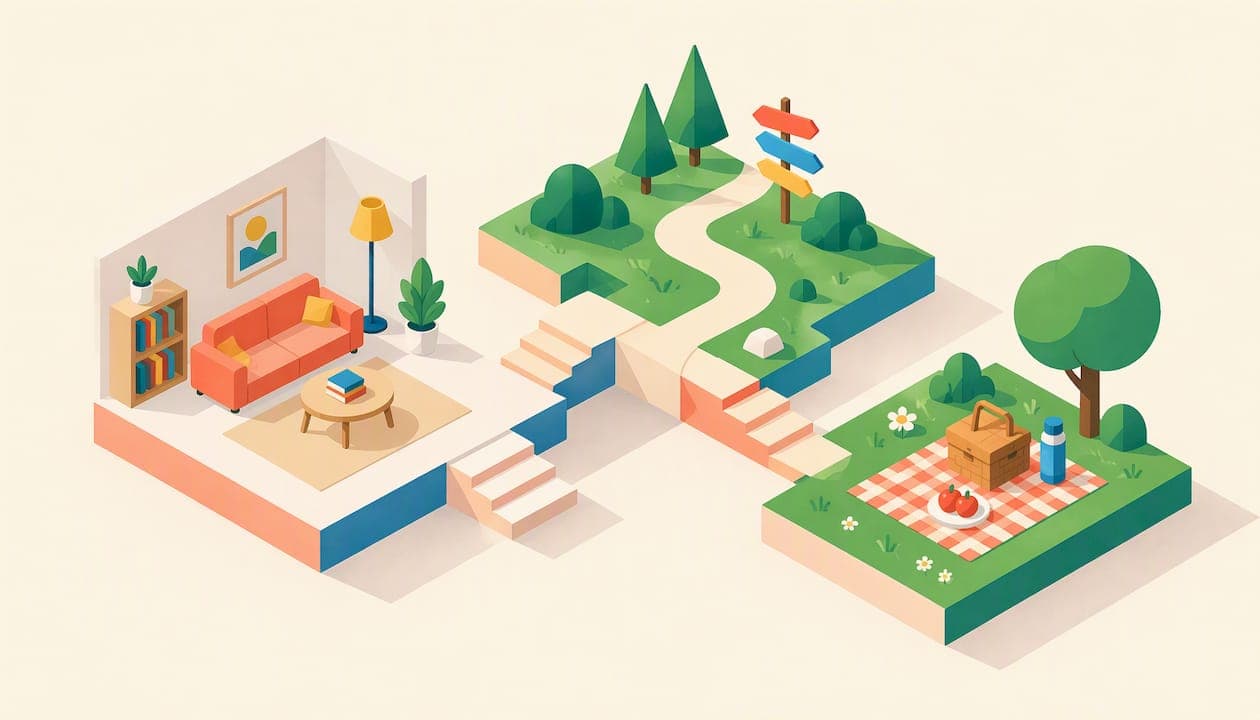
The best weekend activity for a family is one that everyone can join, that costs little and that you can start within the hour. This guide gives you ideas for at home, outdoors and at a picnic. It also shows how to pick one without a 20-minute debate, which is often the hardest part of the weekend.
TL;DR
- Pick from three buckets: at home, outdoors, and picnic or group games. Most weekends need one from each, not a packed schedule.
- Many good ideas are free or cheap: scavenger hunts, indoor picnics, cooking contests, backyard camping, neighborhood walks.
- Pediatric guidance says the specific activity matters less than the time you spend playing together.
- Put your shortlist on a spin wheel and let the spin choose. Nobody can claim a sibling or parent got their way again.
- Plan the safety basics for the activity: a designated water watcher near water, secure backyard equipment, safe routes near traffic.
Table of Contents
- How to choose an activity everyone will enjoy
- Weekend activities at home
- Outdoor weekend activities
- Picnic games for families
- Let a spin wheel choose the weekend
- Build your own family weekend wheel
- Our perspective
- A sample weekend plan
- FAQ
- Sources
How to choose an activity everyone will enjoy
Start with the people, not the list. A weekend plan that suits a four-year-old and a thirteen-year-old rarely looks like one that suits only one of them, so a few quick filters help.
Age. Toddlers do well with water play, simple scavenger hunts and anything that involves moving and touching. School-age kids tend to like contests and projects with a goal: a cooking challenge, a DIY obstacle course or a building project, according to one parenting blog. Teens usually want a say, which is the best reason to share the choosing.

Budget. You do not need tickets. The Family Wellness lists 50 ideas that are either free or under $20, such as an indoor picnic for ages 2 and up or a neighborhood architecture hunt for ages 6 and up. Libraries, nature walks and free community workshops fill a lot of Saturdays.
Weather. Decide your rainy-day backup before you need it. Fort-building, board games and cooking all work indoors, and a good outdoor plan often has an indoor twin (picnic on the lawn, picnic on the living-room floor).
Energy. After a busy week, a low-key Saturday morning followed by one bigger activity in the afternoon often goes better than three outings.
Make the choosing fair
Families tend to argue about who picks, not what to pick. Two habits help. Take turns being the chooser, and talk afterward about what everyone liked so the next choice gets easier. You can also take the decision out of human hands: write the options down, and spin. We cover how below.
Weekend activities at home
Staying in does not have to mean screens. Here are home ideas drawn from a list of 50 family activities and our own experience of what families spin for.
- Build a fort. Blankets, couch cushions and clothespins. Add flashlights and a read-aloud inside.
- Read aloud. One chapter per person, or one person performing all the voices.
- Card and board games. Or invent your own board game with paper, dice and a family-themed rule set.
- Cook together. Give each person a role, or run a cooking contest using ingredients already in the kitchen.
- Indoor picnic. Spread a blanket on the living-room floor and eat lunch there. It works for toddlers and for teenagers who will pretend they are too old for it.
- Photo memory night. Scroll through old photos and let everyone tell the story behind one.
- Put on a play. Write a short script, assign roles, perform for the grandparents on a video call.
- Scrapbook or art project. Doodle together, make cards or assemble a family memory book.
Keep screen time in proportion
A movie night is fine. If you want a rough benchmark, the World Health Organization recommends no screen time for children up to one year old and no more than one hour of sedentary screen time a day for ages 2 to 4, as summarized by UNICEF. Screen-free weekend blocks make those numbers easier to hit without a fight.
Sneak in something useful
The University of Minnesota Extension suggests that teaching kids about money works best woven into daily life, not delivered as a lecture, with conversation starters at mealtime, while washing dishes or in the grocery line. A weekend cooking contest with a small shopping budget is a natural way to try it.

Outdoor weekend activities
Fresh air is the easiest upgrade to a weekend. The same Family Wellness list includes nature scavenger hunts, birdwatching, gardening, picnics, chalk art, neighborhood walks and short nature hikes. A few ways to make them stick:
- Scavenger hunt with a twist. Write 10 items (a smooth stone, something yellow, a feather, three different leaves). Younger kids can tick them off; older ones can photograph them instead of collecting them.
- Backyard camping. A tent, a flashlight and s'mores ingredients if you have them. It costs almost nothing and feels like an adventure.
- Chalk the driveway. Hopscotch, a giant maze, a family portrait. Rain washes it away for the next round.
- Neighborhood walk with a mission. Count dogs, spot unusual doors, find the oldest tree on the block.
- Garden project. Plant something quick like radishes or herbs and check on it each weekend.
- Pick your own fruit. Many farms let you pick by hand, and the University of Minnesota Extension notes that on-farm education helps visitors learn about the crop and the picking experience. Check the farm's own page for seasons and hours.
- Free local events. City and town websites often list free concerts, festivals, farmers' markets and outdoor movie nights, as Timily's family guide suggests. Check the official calendar for this weekend's schedule.
Safety where it counts
Near water, assign one adult as the dedicated water watcher. HealthyChildren.org advises putting phones away during that shift, rotating the duty in larger groups and keeping an adult within arm's reach of young children in the water.

If you walk to a park, choose routes with sidewalks. Where there are none, walk facing oncoming traffic, and make eye contact with drivers before crossing.
If your weekend includes a backyard play structure, the same source recommends anchoring it deeply and securely and laying a 12-inch base of sand, mulch or wood chips beneath it. Ask your pediatrician if you have questions about what suits your child's age and abilities.
Picnic games for families
A picnic is a good excuse for games because everyone is already outside, fed and relaxed. The American Academy of Pediatrics' HealthyChildren.org describes several no-cost, screen-free games that work well on a lawn.
| Game | How it works | What it builds |
|---|---|---|
| Egg race | Balance an egg on a spoon and walk to a finish line | Balance and dexterity |
| Limbo | Players bend backward to pass under a broomstick held low | Flexibility |
| Simon Says | One leader gives commands; follow only the ones that start with "Simon says" | Listening and focus |
| Duck, Duck, Goose | Players sit in a circle while one walks around tapping heads | Movement and turn-taking |
| Tag | One player chases the others | Running and quick reactions |
Use hard-boiled eggs for the egg race if you want an easy cleanup, or swap in a potato for toddlers.
More games that need almost nothing
- Three-legged race. Tie two players' ankles together with a scarf. Mixed pairs, like a parent and a kid, are funniest.
- Sack race. Pillowcases work if you have no burlap sacks.
- Relay with a twist. Each leg of the relay has a different movement: hop, crab walk, walk backward.
- Blanket toss. Let a few players bounce a soft ball on a blanket without letting it fall.
- Name-that-tune. Hum a song and everyone guesses. It works with any age range.
- Cloud shapes. Lie on the blanket, spot shapes and tell a story that links them.
Keep it fair
The fastest way to end a picnic game is a dispute over who goes first, who is on which team or who gets the last turn. Put names on a wheel, spin it and move on. If you are running a bigger gathering, our guide to using a name picker at parties and contests shows how to set up a draw everyone trusts. You can also build a party game wheel with every game on the list and let it choose the order of play.
Let a spin wheel choose the weekend
Here is the simplest way to end the "I don't know, what do you want to do?" loop. Gather the family for two minutes and run this routine.
- Each person adds one or two ideas to a list. Include a mix: one at home, one outdoors, one free, one that costs something.
- Enter the options on a wheel.
- Spin once for Saturday and again for Sunday.
- If someone really dislikes the result, they get one veto per weekend. Spin again.
- Use elimination mode when you want a full ordering: whatever comes up is removed, and you spin again until the whole list is a schedule.
Weights help too. If the kids have been begging for the park, give it two entries so it comes up more often, while the others still have a chance. For a food decision, a restaurant picker wheel removes the Sunday dinner standoff. Around the holidays, our Thanksgiving wheel hands out games and chores, which parents tend to appreciate.
Build your own family weekend wheel
Our free random wheel generator lets you create a custom wheel in a minute. It runs in your browser on a phone, tablet or laptop, with no signup and no download. You can weight the odds, switch on elimination mode, save the wheel and share it with a partner or the grandparents so everyone sees the same list.

If you just want a quick pick from a short list of names or options, the Picker Wheel does the same job in one click. Our results come from a cryptographically secure random number generator, which is designed so each option has an equal chance on every spin unless you choose to weight it. The tool is free to use.
Our perspective
We built Spin Wheel Names for classrooms, raffles and team meetings, and families turned out to be some of the most enthusiastic users. The reason is simple: a group decision only feels fair when nobody controls it.
At the weekend, the person who suggests the activity is usually the person who ends up resented for it. A wheel changes that. The pick is visible, random and not up for debate, and the spin itself becomes part of the fun. Kids who would argue with a parent will accept a wheel, because nobody can accuse it of favorites.
We also believe the list matters more than the tool. The pediatric guidance we cite elsewhere in this article makes the same point: the specific activity matters less than the time you spend together. So keep your list wide, include silly options, and let the spin do the hard part. Our design goal is to keep the tool instant, free of signup and usable on any device, so the choosing takes seconds and the weekend takes the rest.
Luke
A sample weekend plan
Here is how one family might use the ideas above. Swap in your own list.
Saturday
- Morning: spin for a home activity (cooking contest, fort-building, board game tournament).
- Afternoon: spin for an outdoor option (neighborhood scavenger hunt, local park, farmers' market).
Sunday
- Late morning: picnic in the yard or a nearby park with three games chosen by the wheel.
- Evening: a quiet activity (read-aloud, photo memory night, family play), then a screen-free wind-down.
If the weather turns, spin again from the indoor list. If a child is tired, drop the afternoon slot. A plan that bends is a plan that survives a real weekend.
Tips that make any activity go better
- Set the list in advance. Keep a running note on the fridge or phone so ideas collect all week.
- Rotate roles. Whoever lost the last spin chooses the snacks, the music or the playlist.
- Limit the setup. If an idea needs a shopping trip and 40 minutes of prep, put it on the "someday" list.
- Debrief for a minute. Ask what everyone liked best. Over a few weekends, you learn what your family actually enjoys, not what you assumed.
- Include one thing you have never done. Novelty gives you stories to retell.
FAQ
What are good weekend activities for families on a small budget?
Nature walks, scavenger hunts, indoor picnics, backyard camping, library visits and cooking contests with food you already own all cost little or nothing. The Family Wellness lists many ideas that are free or under $20. Check your city or town website for free community events too.
What can we do at home on a weekend without screens?
Build a fort, play card or board games, cook together, hold an indoor picnic, look through photos or stage a short play. Each of these gets everyone involved and needs only things you have in the house. Keep a list handy so you do not default to a show.
What are easy picnic games for families?
Egg races, limbo, Simon Says, Duck, Duck, Goose and tag all need almost no equipment, and HealthyChildren.org describes them as simple, screen-free play. Add three-legged races and relays for bigger groups. Use a wheel to pick teams and the order of play.
How do we pick an activity when everyone wants something different?
Collect one or two ideas from each person, put them on a wheel and spin. Take turns being the chooser the next time, and give each person one veto. Because the result is random, nobody has to feel overruled.
Is a spin wheel really random?
Our wheel uses a cryptographically secure random number generator, which is designed to give every entry an equal chance on each spin unless you set weights yourself. You can see the list before you spin, so the whole family can check what is on it.
Sources
- Family Activities: 50 Ideas to Do Together at Home and Outdoors, The Family Wellness
- 30+ Weekend Activities for Dads and Kids, The Best Dads
- 10 Tips to Reduce Your Child's Screen Time, UNICEF India
- Activities to teach families and youth about finances, University of Minnesota Extension
- Honeyberries (Haskap) as a U-Pick Crop for Minnesota, University of Minnesota Extension
- Screen-Free Family Activities: 50+ Ideas by Age, Season, Timily
- Beach Safety for Families, HealthyChildren.org
- Pedestrian Safety Tips for Families, HealthyChildren.org
- Playing Outside in the Yard: 8 Tips to Keep it Fun and Safe, HealthyChildren.org
- 10 No-Cost, Screen-Free Activities to Play with Your Child, HealthyChildren.org